How we picked
We do not lab-test binoculars. These picks are built from two things: the manufacturers' published specifications, and the buying guidance that the Cornell Lab of Ornithology and Audubon publish for birders. Where a claim is the maker's own (for example, "ED glass"), we say so. We recommend reading an independent hands-on test too, such as the Cornell Lab's review of affordable 8x42s.
What actually matters for birding
Magnification: 8x is the safe default
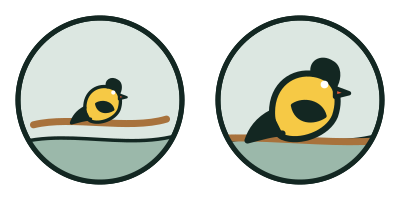
Both Cornell's and Audubon's guides steer birders toward 7x to 8x: you get a wider field of view, so birds are easier to find and follow, and the image is steadier in your hands. 10x brings birds closer but narrows the view and magnifies hand shake. See our 8x42 vs 10x42 breakdown for the numbers.
The second number: objective lens size and brightness
In "8x42", 42 is the front lens diameter in millimeters. Bigger lenses gather more light. Divide the lens size by the magnification to get the exit pupil (42 ÷ 8 = 5.25 mm). A larger exit pupil generally looks brighter in woods and at dawn or dusk. A 8x25 pocket model has a 3.1 mm exit pupil, which is why pocket binoculars look dimmer in low light.
Field of view
Listed as feet at 1,000 yards. More feet means a wider scene, which makes it easier to locate a warbler in a tree. It is the single spec most people overlook.
Close focus
The nearest distance you can focus on. Shorter is better for butterflies, dragonflies and birds that pop up in a nearby bush.
Eye relief (if you wear glasses)
Eye relief is how far your eye can sit behind the eyepiece and still see the full image. As a rule of thumb, eyeglass wearers should look for twist-up eyecups and eye relief of roughly 15 mm or more, and should try the pair on with their glasses.
Weight and comfort
Heavy binoculars stay in the bag. Both Cornell and Audubon recommend trying models in person and weighing image quality, focus feel, weight and warranty together, not just the spec sheet.
Side-by-side (manufacturer specs)
| Model | Field of view | Weight | Close focus | Eye relief | Exit pupil |
|---|---|---|---|---|---|
| Celestron Nature DX 8x42 | 388 ft | 22.2 oz | 6.5 ft | 17.5 mm | 5.25 mm |
| Vortex Diamondback HD 8x42 | 393 ft | 21.8 oz | 5.0 ft | 17.0 mm | 5.25 mm* |
| Nikon Monarch M5 8x42 | 335 ft | 22.2 oz | 8.2 ft | 19.5 mm | 5.3 mm |
| ZEISS Terra ED 8x32 | 405 ft | 18.0 oz | 5.3 ft | 16.5 mm | 4.0 mm |
| ZEISS Terra ED Pocket 8x25 | 357 ft | 10.9 oz | 6.2 ft | 16.0 mm | 3.1 mm |
Field of view in feet at 1,000 yards. *Vortex does not list exit pupil on its page; 5.25 mm is calculated as 42 ÷ 8. Zeiss lists eye relief as "exit pupil distance".
The picks
Best budget all-rounder
Celestron Nature DX 8x42
Celestron describes this as an entry point into serious sport optics, with phase-coated prisms, fully multi-coated optics, twist-up eyecups and a limited lifetime warranty. Celestron's own page notes it was ranked top of the under-$200 category in Audubon magazine's 2016 binocular guide by volunteer testers, a useful data point, though an older one.
- Field of view
- 388 ft @ 1,000 yd (7.4°)
- Weight
- 22.2 oz
- Close focus
- 6.5 ft
- Eye relief
- 17.5 mm
- Prisms
- BaK-4, phase-coated
- Protection
- Waterproof, nitrogen-filled
Good for: First pair of serious binoculars, or a backup pair you will not worry about getting wet.
Trade-off: Close focus is the longest of the 42 mm class here except the Nikon, and at this price tier you should not expect the glass quality of premium models.
Best value in a full-size 8x42
Vortex Diamondback HD 8x42
On paper this has the widest field of view and the shortest close focus of the three 8x42 models here, and it is the lightest of them. It also includes a harness-style carrying system and tethered lens covers in the box, per Vortex's page.
- Field of view
- 393 ft @ 1,000 yd (7.5°)
- Weight
- 21.8 oz
- Close focus
- 5.0 ft
- Eye relief
- 17.0 mm
- Coatings
- Fully multi-coated, dielectric prism coating, phase correction
- Protection
- Waterproof, fogproof, argon-purged
Good for: Birders who want a wide field of view and close focus without paying for a premium brand.
Trade-off: Vortex markets this line first to hunters. It lists wildlife observation as a recommended use, and the specs suit birding, but check fit and weight in your hands.
Best for eyeglass wearers (on paper)
Nikon MONARCH M5 8x42
Nikon lists extra-low-dispersion (ED) glass, which the maker says reduces color fringing. That is a manufacturer claim, so compare it in person with the Vortex if you can.
- Field of view
- 335 ft @ 1,000 yd (6.4°)
- Weight
- 22.2 oz (629.3 g)
- Close focus
- 8.2 ft
- Eye relief
- 19.5 mm
- Glass
- ED glass, phase and dielectric coatings
- Protection
- Waterproof to 3.3 ft, nitrogen-filled
Good for: Glasses wearers (longest eye relief listed here) who want ED glass in a mainstream, widely-reviewed model.
Trade-off: Narrowest field of view and longest close focus of the group, so it is slightly harder to find birds fast and to watch things at your feet.
Best lightweight all-day pair
ZEISS Terra ED 8x32
Zeiss positions Terra ED as an entry to its premium optics. Compared with the 8x42 models here, you save roughly 4 oz and gain field of view, and you give up some low-light brightness.
- Field of view
- 405 ft @ 1,000 yd (61° apparent)
- Weight
- 18.0 oz (510 g)
- Close focus
- 5.3 ft (1.6 m)
- Exit pupil distance
- 16.5 mm
- Light transmission
- 88% (maker figure)
- Protection
- Waterproof to 100 mbar, nitrogen-filled
Good for: Long days on foot, smaller hands, or anyone who leaves heavy binoculars at home. Widest field of view in this lineup.
Trade-off: A 4.0 mm exit pupil is dimmer than a 42 mm model at dawn, dusk and in dense woods. Whether that matters depends on when and where you bird.
Best pocket pair
ZEISS Terra ED Pocket 8x25
At 10.9 oz it is roughly half the weight of the 8x42 models above. That is the whole pitch.
- Field of view
- 357 ft @ 1,000 yd
- Weight
- 10.9 oz (310 g)
- Close focus
- 6.2 ft (1.9 m)
- Exit pupil distance
- 16.0 mm
- Exit pupil
- 3.1 mm
- Protection
- Waterproof to 100 mbar, nitrogen-filled
Good for: Travel, hikes where birds are a bonus, and as a second pair that always lives in your jacket.
Trade-off: Smallest objective lenses means the dimmest view in low light. We would not make these your only birding binoculars unless weight is a hard constraint.
Modern optics we like
Newer compact binoculars from NOCS Provisions that caught our eye. They are not part of the ranking above, and we have not compared them with the five picks or tested them. Every number comes from NOCS’s own product pages.
The pocket one
Standard Issue 8x25
NOCS calls it their most packable binocular: small and light, with fully multi-coated lenses and BaK4 roof prisms.
- Magnification
- 8x
- Objective lens
- 25 mm
- Field of view
- 357 ft @ 1,000 yds
- Weight
- 11.85 oz (336 g)
- Waterproof
- IPX7 (per NOCS)
The in-betweener
Field Issue 8x32
The mid-size option: a larger objective than the Standard Issue, with what NOCS calls HiFi fully multi-coated lenses.
- Magnification
- 8x
- Objective lens
- 32 mm
- Field of view
- 387 ft @ 1,000 yds
- Weight
- 16.7 oz (473 g)
- Waterproof
- IPX7 (per NOCS)
The full-size one
Pro Issue 8x42
NOCS’s top binocular line: phase-coated BaK4 prisms and broadband fully multi-coated optics, in a 42 mm body.
- Magnification
- 8x
- Objective lens
- 42 mm
- Field of view
- 429 ft @ 1,000 yds
- Weight
- 1.5 lb (680 g)
- Waterproof
- IPX7 (per NOCS)
Specs and product descriptions: NOCS Provisions, checked October 25, 2026. Field of view is NOCS’s figure for the 8x model. Illustrations are ours, not NOCS photos; NOCS is a trademark of its owner. Bird Bro is not affiliated with or endorsed by NOCS Provisions, and we do not currently earn a commission on these links. Check NOCS for current pricing and availability.
Which one should you buy?
- Not sure, want one pair for everything: 8x42. Choose between the Celestron (lowest cost tier) and Vortex (wider view, closer focus).
- You wear glasses: prioritize eye relief and try the pair on with your glasses. The Nikon's 19.5 mm is the longest here.
- Neck or shoulder trouble, or kids: 8x32 (Zeiss Terra ED) or a pocket model.
- Mostly open habitat, shorebirds, waterfowl: consider 10x42. See the 8x42 vs 10x42 guide.
Tips before you buy
- Try before you buy if you can. A local birding or outdoor shop will let you compare focus feel, weight and eyecups.
- Check the warranty and return policy. A good warranty is worth more than a small spec advantage.
- Skip "zoom" binoculars and anything advertising huge magnification for the price. For birding, steady and bright beats powerful.
- Never look at the sun through binoculars.
Not sure yet?
Try a few pairs in person at a local optics or birding store if you can. Prices and stock change often, so we do not list them here. Our 8x42 vs 10x42 guide covers the most common decision. Choosing by budget tier? See binoculars by budget. Buying for someone else? Try our beginner gift guide. For distant birds on water or mudflats, see our spotting-scope guide.